

Moving in Fort Worth isn’t just about how many bedrooms you have. A move from a spacious home in Arlington Heights to another nearby house can be relatively straightforward, while an apartment move downtown may involve elevators, loading zones and a much longer carry.
So, how much do movers cost in Fort Worth? In 2026, local full-service moves commonly fall somewhere between $331 and $2,596, according to recent Fort Worth moving-cost data, with the actual price depending heavily on crew size, time, access and services.
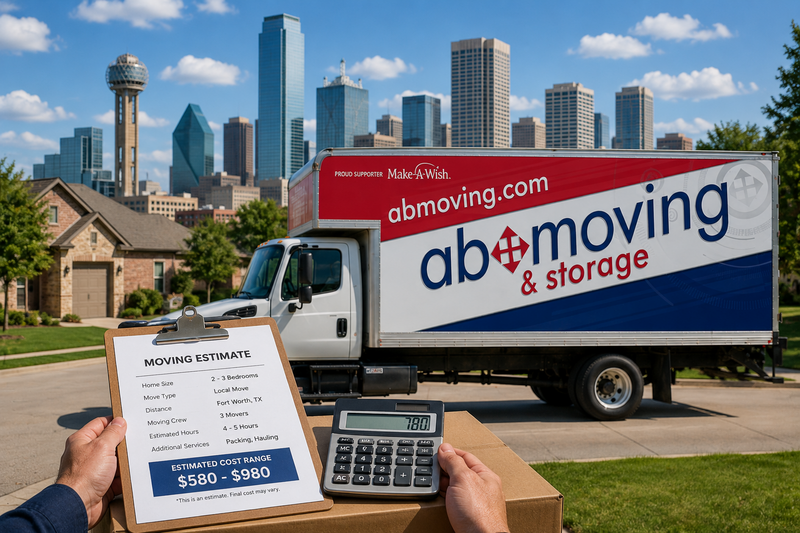
Most local Fort Worth moves are priced hourly. Here is a basic calculation to consider:
Number of movers × hourly rate × billable hours = labor cost
Recent Fort Worth data reports local moving costs of approximately $331–$2,596 for full-service moves. Reported ranges include about $215–$439 for studio or one-bedroom moves, $440–$677 for two-bedroom moves, and $971–$1,706 for three- to four-bedroom moves.
Those numbers are useful for budgeting, but don’t treat them as a guaranteed quote. Your actual price can change based on:
For example, a three-person crew working six hours at $100 per hour would produce:
3 × $100 × 6 = $1,800 in labor
If the company charges additional truck, travel or specialty fees, the final price could be higher.
That’s why an experienced Dallas-Fort Worth mover should ask about your property and inventory before giving you a meaningful estimate.
A local pricing example
Consider two hypothetical two-bedroom moves.
Move A: A house in Wedgwood with a driveway, easy truck access and everything packed before the crew arrives.
Move B: A downtown apartment where movers need to reserve a freight elevator, park farther from the entrance and carry furniture through common areas.
Even though both customers have two bedrooms, Move B can take considerably longer. The difference isn’t the number of bedrooms—it’s the amount of labor involved.
Bedrooms are a useful starting point, but professional movers ultimately care about volume, access and labor time.
Studio or one-bedroom
A small apartment may only require two movers for a few hours. However, elevators, stairs and limited parking can increase the time.
Recent Fort Worth estimates put studio and one-bedroom local moves at roughly $215–$439 in one customer-backed dataset.
Two-bedroom
A two-bedroom apartment or house commonly needs a larger crew or several hours of labor. Recent local data puts this category around $440–$677, although individual quotes can be considerably higher depending on access and service level.
Three- and four-bedroom homes
Larger homes often require more movers, more truck space and more loading time. Recent Fort Worth data places three- to four-bedroom moves around $971–$1,706.
A large home with extensive furniture, garage contents, outdoor equipment or specialty items can go beyond those figures.
If you’re moving a larger household, don’t rely on a bedroom count alone. Give the mover an inventory or arrange an in-home or virtual estimate whenever possible.
Fort Worth has a mix of historic neighborhoods, newer master-planned communities, downtown apartments and sprawling suburban homes. That variety creates some very different moving conditions.
Stairs and elevators
An apartment near Downtown Fort Worth or the Near Southside may have building-specific moving requirements, elevator reservations or limited loading access.
A house in a suburban neighborhood may allow the truck to pull directly into the driveway where as another location might need to pay for parking or park further away.
Those differences can have a meaningful effect on labor time.
Parking and long carries
The distance between the truck and your front door matters.
If a crew can park next to the garage, furniture can move quickly. If the truck has to park down the street, every piece requires additional walking time.
Historic areas such as Fairmount can also present tighter streets and more complicated access than newer suburban developments.
Packing
Professional packing is convenient, but it adds to the moving budget.
If you’re trying to control costs, pack books, clothing and ordinary household goods yourself. You can still have movers handle large furniture, fragile pieces and the heavy lifting.
Specialty items
Tell your mover about pianos, safes, oversized sectionals, large appliances, antiques and other unusually heavy or fragile items before moving day. Those items require special care.
Careful handling of specialty items can require additional equipment, labor or expertise.
Summer heat
Fort Worth summers can be rough on movers. Recent local moving data notes that summer temperatures can reach the mid-90s and that summer weekends and end-of-month dates can command higher prices.
If your schedule is flexible, a weekday or less-demanded date may be easier on both your budget and the crew.
Moving across Fort Worth vs moving to another state, isn’t priced the same way.
For a local move, hourly labor is a major cost factor. For long-distance moves, pricing is generally driven by more factors such as shipment size or weight, mileage, origin, destination and selected services. Recent Fort Worth data puts long-distance moves at approximately $1,530–$8,670+, depending on the shipment and route.
Distance matters when comparing quotes.
A $1,200 local moving estimate isn’t necessarily less expensive than a $3,500 long-distance quote. They represent different transportation requirements and pricing models.
Moves in DFW move can vary significantly. For example, recent pricing data for the roughly 32-mile Dallas-to-Fort Worth route shows a wide range based on home size and service type.
Use comparable quotes for the same route and same service level.
Local knowledge is particularly valuable in a city as spread out as Fort Worth.
Moving into Arlington Heights, for example, may involve older homes and established streets, while newer areas toward Alliance can have different access considerations, construction activity and community rules.
Fairmount and other historic areas may require more attention to street access and parking. Downtown and Near Southside apartment buildings can introduce elevator reservations, loading areas and building insurance requirements.
Meanwhile, moves in neighborhoods such as Wedgwood or other suburban areas may have easier driveway access but larger homes and greater furniture volume.
These aren’t hard-and-fast pricing rules. They’re examples of why a mover who understands the local area can ask better questions before moving day.
How to Get an Accurate Moving Quote in Fort Worth
The most useful quote is one based on your actual move details.
Before requesting estimates, gather:
Make sure the quoted price includes.
We recommend getting up to 3 quotes for a true comparison. A labor-only company, a full-service mover and a container company aren’t providing the same service, so comparing their headline prices doesn’t tell you much.
Verify the mover before you book
Texas requires household-goods movers operating within the state to have an active TxDMV certificate. The Texas Department of Motor Vehicles provides a searchable database where consumers can check a mover’s licensing status.
Be sure to take this step before handing over a deposit.
TxDMV also cautions consumers against choosing a mover based solely on the lowest price. A legitimate mover should provide appropriate proposal and contract documents and explain your rights and responsibilities before loading your belongings.
Be sure to check the mover through the official TxDMV Motor Carrier Lookup before booking.
Get rid of what is no longer serving you. Donate or sell furniture and household goods you no longer use before getting your quote.
Next, do as much preparation beforehand as you can. Pack regular items, label boxes by room and clear walkways before the movers arrive.
For apartments, see about reserving the elevator and loading area in advance. For houses, confirm where the truck can be parked.
If you have flexibility, ask for a non-peak moving slot. A weekday or off-peak date may provide better availability than a weekend at the end of the month.
The goal isn’t simply to find the lowest hourly rate, it’s to minimize the total amount of labor required for your trusted move.
Choose a Fort Worth Moving Company With Clear Pricing
A reputable mover will be patient in explaining its rates and answering questions before you book.
Look for:
Be cautious when a company offers an unusually low price without asking about information of your move including but not limited to: your inventory, your accessibility and/or moving date.
Ready to start planning? Explore our moving services to find the right level of help for your Fort Worth relocation, or get a free quote to request a quote.
Fort Worth moving rates vary by company, crew size and what all is included. Local data reports an average of about $80 per hour for local moves, while individual companies and service packages can differ substantially.
Ask what the hourly rate includes. Does the quoted hourly rate include the truck, travel time, equipment and other fees? Ask this before comparing it with another company’s rate.
A small local move may cost a few hundred dollars, while a two- or three-bedroom move can reach $1,000 or more. Larger homes, full-service packing and difficult access can push the total considerably higher.
Recent Fort Worth data places full-service local moves at roughly $331–$2,596, but your actual quote will depend on your inventory, access, crew requirements and moving date.
For the most accurate number, request a written estimate based on your specific move.